Covariance & Correleation Matrix Pearson Correlation
In probability covariance is the measure of the joint probability for two random variables. It describes how the two variables change together
It is denoted as the function cov(X,Y) Where X and Y are the two random variables being considered
cov(X,Y)
Covariance is calculated as the expected value or average of the product of the differences of each variable from theor expectedvalues ,Where E[X] is the expected value for X and E(Y) is the expected value of y.
in simple terms

cov(X,Y)=E[ ( X - E[X] ) . ( Y - E[Y] ) ]
for n values
cov(X,Y)=sum(E[ ( X - E[X] ) . ( Y - E[Y] ) ]) * 1/n
or,
cov(X,Y)=sum([ ( X - X^ ) . ( Y - Y^ ) ]) * 1/n
sum is upto n
A variance value of zero are completely indicated that both variables are independent
in numpy we use conv() to find covariance
Note. It doesn't show how much negativity and positivity it brings so for this we calculate correlation
PEARSON CORRELATION COEFFICIENT.
It always range between -1<corr<1
corr=cov(x,y)/standard_deviation(X)*standard_deviation(Y)
X increasing,Y increasing then corr=1
X decreasing,Y increasing then corr=-1
when I have a scatter plot then my covariance is 0 because in scater plot when my X is increasing and y is decreasing and vice versa
When some of the points fitted the line and X is decreasing and Y is Increasing then My corr is from -1 <corr<0
When some of the points fittedthe line and X is increasing and Y is increasing then my corr is from 0 to 1
SPEARMAN'S RANK CORRELATION:
In Spearman correlation we use rank instead of x we use their ranks to find out the correlation between them
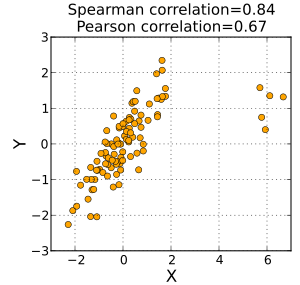
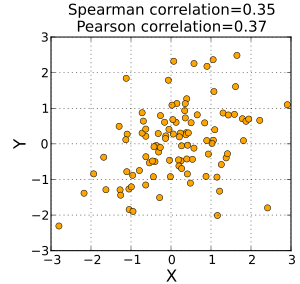
This is the formula we use to calculate the spearman correlation
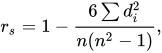
- Sort the data by the first column (). Create a new column and assign it the ranked values 1, 2, 3, ..., n.
- Next, sort the data by the second column (). Create a fourth column and similarly assign it the ranked values 1, 2, 3, ..., n.
- Create a fifth column to hold the differences between the two rank columns ( and ).
- Create one final column to hold the value of column squared.


| IQ, | Hours of TV per week, |
|---|---|
| 106 | 7 |
| 100 | 27 |
| 86 | 2 |
| 101 | 50 |
| 99 | 28 |
| 103 | 29 |
| 97 | 20 |
| 113 | 12 |
| 112 | 6 |
| 110 | 17 |
| IQ, | Hours of TV per week, | rank | rank | ||
|---|---|---|---|---|---|
| 86 | 2 | 1 | 1 | 0 | 0 |
| 97 | 20 | 2 | 6 | −4 | 16 |
| 99 | 28 | 3 | 8 | −5 | 25 |
| 100 | 27 | 4 | 7 | −3 | 9 |
| 101 | 50 | 5 | 10 | −5 | 25 |
| 103 | 29 | 6 | 9 | −3 | 9 |
| 106 | 7 | 7 | 3 | 4 | 16 |
| 110 | 17 | 8 | 5 | 3 | 9 |
| 112 | 6 | 9 | 2 | 7 | 49 |
| 113 | 12 | 10 | 4 | 6 | 36 |
With found, add them to find . The value of n is 10. These values can now be substituted back into the equation
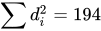
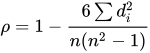
to give
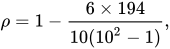
which evaluates to ρ = −29/165 = −0.175757575... with a p-value = 0.627188 (using the t-distribution).
That the value is close to zero shows that the correlation between IQ and hours spent watching TV is very low, although the negative value suggests that the longer the time spent watching television the lower the IQ.

Little Standard Error show less collinearity between variables
If their is high collinearity between two variables ad if we want to remove the collinearity between them then we just drop them by seeing the P value of any one of them whichever variable have high P value then we drop that variable


Comments
Post a Comment